
· by Michael Blair, Nashville's Air Duct Cleaning
A filter rating measures how small a particle the filter catches. Catching smaller ones takes either tighter media, which resists the air, or more media surface, which spreads the air out, and the Building America Solution Center’s guide to high-MERV filters shows how much deeper pleats or a bigger filter bring the resistance down. Trouble starts when a house gets the tighter media without the extra surface.
What does a MERV rating mean?
MERV stands for Minimum Efficiency Reporting Value. EPA’s explainer on MERV ratings describes it as a filter’s ability to capture particles between 0.3 and 10 microns, and the higher the number, the better the filter traps specific sizes. In EPA’s table, MERV 1 to 4 catches under 20 percent of the 3 to 10 micron range, while MERV 13 catches 50 percent or more of the finest band, 0.3 to 1 micron.
The cheap fiberglass filter still does something. EPA’s Indoor airPLUS technical bulletin on filtration puts a typical one-inch spun fiberglass furnace filter at MERV 1 to 4 and says it traps sawdust, carpet fibers, dust mites and pollen, while a MERV 8 can take out mold spores, cement dust and pet dander. Rating is not the same as airflow resistance, though the same bulletin notes that higher MERV filters do tend to restrict airflow, and on a one-inch filter the two climb together.
Why can a high-MERV filter choke the system?
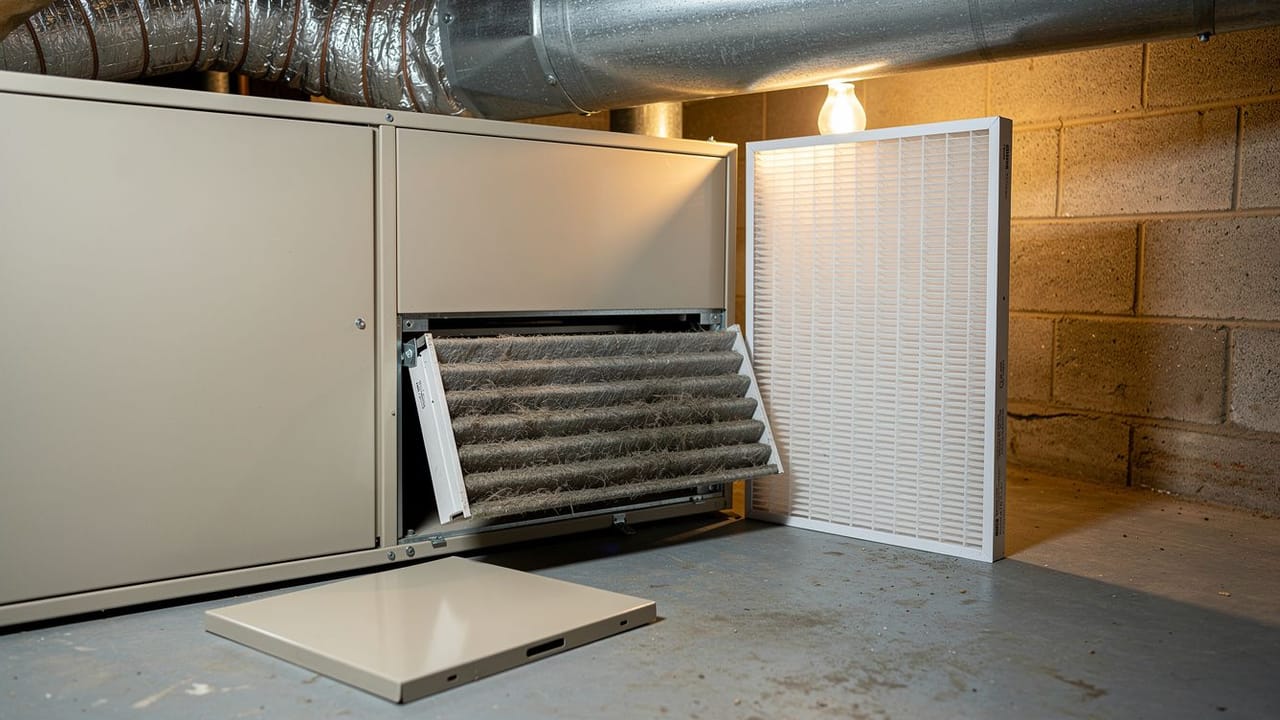
A high-rated one-inch filter has the same face area as a basic one and finer media, so resistance rises. The Building America guide says airflow slows as system pressure climbs, which raises energy use, and that excessive pressure drop can overheat a furnace, freeze the air conditioner’s coil and burn out the blower motor. The same pressure problem is behind why closing vents in unused rooms backfires. When the coil behind a too-tight filter has already iced or matted over, cleaning it is part of our coil and blower service.
The fix is more surface area. In that guide’s comparison, a one-inch filter showed 0.20 inches of water column at 300 feet per minute and a four-inch filter 0.12, and EPA’s bulletin says thicker or wider filters generally create less static pressure. If you do upgrade, EPA suggests at least MERV 13 or as high a rating as your system fan and filter slot can accommodate, and an HVAC technician can tell you where that limit sits for your equipment.
- Ask what MERV your blower and filter slot can take before upgrading
- Four-inch or deeper media brings a high rating with less restriction
- Check the filter seals in the track, not just its rating
- Look at a one-inch filter monthly and change it on its maker’s schedule
- Media filters go by their maker’s schedule too
A rating only counts if the filter seals
Air takes the easiest path. EPA’s bulletin calls for a filter slot sealed so there is no path for air around the filter, with a flexible, air-tight gasket on the access panel. Any air that slips through a gap at the edge skips the media altogether, so for that share of the air the number on the frame makes no difference. It is one of the first things we look at when dust keeps coming back after a duct cleaning.
The Building America guide adds that the slot cover should fit tightly but should not be taped or caulked, since the filter has to come out for changing. Each time you swap the filter, check that it is the right size for its track and that the cover sits flush.
Intervals in Middle Tennessee
We can’t point you to a published month count for this area. EPA’s MERV page says every filter needs periodic replacement and tells you to follow the manufacturer’s recommendations, so the maker’s schedule is the starting point. We’d look at a one-inch filter every month and change it ahead of that schedule in a house with pets, heavy dust or a renovation underway. A deeper media filter goes by its own maker’s interval as well.
EPA’s bulletin is blunt about a neglected filter: a dirty, clogged one can dramatically reduce airflow, adding to furnace run time, motor wear and energy use. If you’d like someone to look over the slot, the cover and the filter while we’re there for the ducts, ask for a free estimate.
Sources
- US EPA, What is a MERV rating? — MERV covers 0.3 to 10 micron particles; higher traps smaller; MERV 1-4 and MERV 13 capture figures; at least MERV 13 or as high as the fan and slot accommodate; consult a technician; follow the manufacturer on replacement
- US EPA, Indoor airPLUS Technical Bulletin: Filtration (EPA 402/B-20/006, 2019) — Fiberglass filter is MERV 1-4 and traps pollen and dust mites; MERV 8 catches mold spores and dander; higher MERV tends to restrict airflow; thicker filters create less static pressure; sealed slot and air-tight gasket; clogged filter cuts airflow and raises run time, wear and energy use
- DOE/PNNL Building America Solution Center, High-MERV Filters (2022) — Surface area lowers pressure drop; 1-inch 0.20 vs 4-inch 0.12 in. WC at 300 FPM; pressure drop raises energy use, overheats furnaces, freezes coils, burns out blowers; slot cover tight but not taped or caulked
FAQ
Choosing an HVAC Filter Without Choking the System — questions
Is a higher MERV filter always better?
No. EPA suggests at least MERV 13 if you upgrade, but only as high as your system fan and filter slot can accommodate. On a one-inch filter a higher rating means finer media in the same face area, which raises resistance and cuts airflow, and the Building America Solution Center ties excessive pressure drop to higher energy use, iced coils and overheated furnaces. A higher rating belongs in a filter with more surface area, such as four-inch or deeper media.
How often should I change my filter in Nashville?
There is no Nashville-specific figure we can point to, so follow the filter maker’s schedule, which is what EPA recommends. Check a one-inch filter every month and change it sooner if it looks loaded, especially with pets or construction dust in the house. A media filter four inches deep or more also goes by its maker’s schedule. A dirty, clogged filter can sharply reduce airflow and add to run time, motor wear and energy use.
Why does filter sealing matter?
Because air takes the easiest path. If the filter does not seal in its slot, some of the air goes around it unfiltered, whatever the rating. EPA’s filtration bulletin calls for a sealed slot with an air-tight gasket on the access panel, and the Building America Solution Center says the cover should fit tightly without being taped or caulked shut, so the filter can still be changed.
What MERV rating do I need for a home with pets?
A MERV 8 can take out pet dander, according to the EPA’s filtration bulletin, and the EPA suggests at least MERV 13 if your system fan and filter slot can take it. Pets load a filter faster, so look at a one-inch filter every month and replace it ahead of its maker’s schedule.