
· by Michael Blair, Nashville's Air Duct Cleaning
Mice move toward warm buildings as the nights cool: UC IPM’s Pest Note on the house mouse says they frequently enter homes in autumn when nighttime temperatures drop. A Middle Tennessee house with its ducts in a vented crawl space or an attic can give them a sheltered run that connects to every room, and the first hint is often a smell from the registers the week the heat comes on, one that was not there in the spring. Rodents in the ducts are one of the three situations in which the EPA’s guide to residential duct cleaning says cleaning is worth considering, a short list our post on when duct cleaning is actually justified goes through. Cleaning is part of the answer, but only part, and doing it in the wrong order means paying for it twice.
How do mice get into a duct system?
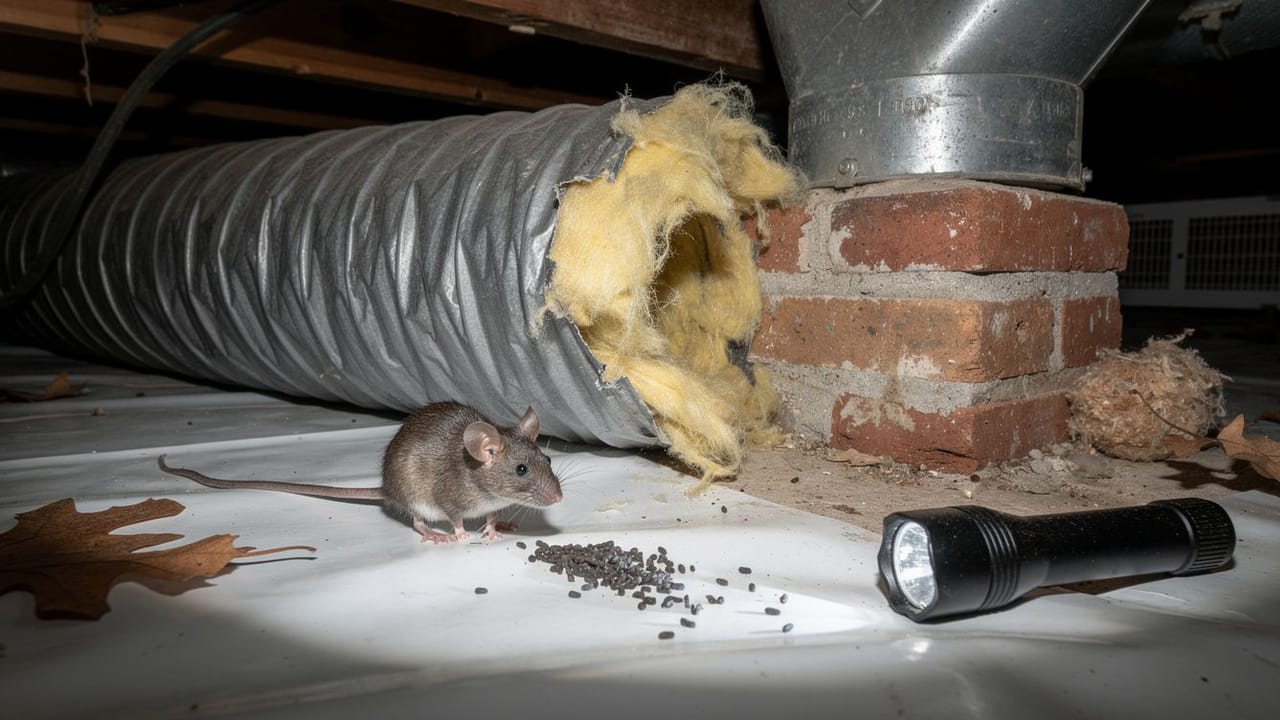
Flexible duct is a common way in. DOE’s Building America guide to duct systems describes it as a flexible plastic-and-wire composite and notes that flex sections may have been torn during installation or afterward, and Missouri Extension’s guide to controlling house mice counts plastic among the gnawable materials that will not stop a mouse. Runs that have come loose from their boots, sagging sections lying on the crawl space floor and joints held with tape that let go long ago leave openings without any chewing at all. The same DOE guide says duct tape often loses its grip after a few years, and ENERGY STAR’s duct sealing page names the connections at vents and registers as common places to find leaks and disconnected ductwork. The gap does not have to be big: UC IPM says a house mouse can squeeze under a gap a quarter inch tall.
The return side is the worse problem. Builders sometimes use the space between floor joists as part of the duct system, DOE notes, and a panned-over joist bay or a return platform in the crawl space can have leakage paths a sealed duct would not. The return runs at low pressure, so any gap in it draws crawl space air, and whatever is living there, into the system. Anything a mouse leaves on the return side is sitting in the air headed for the blower.
Signs that point to the ducts rather than the walls
Missouri Extension says house mice have a characteristic musky odor that identifies their presence, and UC IPM adds that it is common in large or long-term infestations. A musky smell that shows up when the system starts and fades when it stops is the one that points at the ducts, because it follows the airflow rather than a room. Droppings on the floor right under a register, or visible when the grille comes off, are another; both extension guides put droppings first among the signs of mouse activity. Mice are most active at night, so scratching in the floor near a vent after the house goes quiet is worth a look too.
Look under the house with a flashlight if the crawl space is reachable. Chewed flex, insulation pulled out in tufts and nests near the air handler, which UC IPM describes as finely shredded paper or other fibrous material in a sheltered spot, all point to mice, and they also show where the damage is, which matters for what comes next.
- A musky smell that comes and goes with the blower
- Droppings at or inside the registers
- Scratching near a vent after dark
- Chewed flex or pulled insulation under the house
- Nesting material near the air handler or return
What order does the work have to happen in?
Entry points first. UC IPM calls exclusion the most successful and permanent form of house mouse control, and it wants foundation cracks and the openings around pipes, vents and utility lines sealed with metal or concrete; expanding foam, plastic, rubber, vinyl and wood are ineffective as plugs, and steel wool works only as a temporary one because it may rust. The mice already inside have to be dealt with too, which is pest control work, and the CDC’s guidance on cleaning up after rodents says to call a professional rodent exterminating service when there is evidence they have reached the heating and cooling system. Ducts the mice can still get into will need cleaning again.
Then the ducts get repaired. We replace chewed flex rather than patching it, because the liner is what keeps the air in, and the CDC’s cleanup steps treat insulation fouled with urine and droppings as something to bag up and remove. Loose runs are reattached and sealed at the boots with mastic or metal tape, never duct tape, which ENERGY STAR says is not long-lasting, and an open return platform is sealed or rebuilt. Only then does cleaning make sense. Our air duct cleaning puts the system under negative pressure so nothing loosened ends up in the rooms, takes in the coil and blower wheel, and ends with a new filter. The EPA asks for the same scope: its consumer checklist wants every component cleaned, coils and fans included, because one left dirty can re-contaminate the whole system.
Handling droppings safely
Do not sweep or vacuum droppings, at a register or anywhere else. The CDC says doing so can send tiny droplets containing viruses into the air, and UC IPM notes that house mouse urine is a major source of allergens. The CDC’s steps are to open the doors and windows for 30 minutes and stay out while the space airs, put on rubber or plastic gloves, spray the droppings until very wet with a disinfectant or a fresh bleach solution of 1.5 cups of household bleach to a gallon of water, let it soak for five minutes or as long as the label says, and wipe it up with paper towels.
Fogging or spraying a sanitizer into the ducts is not a substitute for taking the contamination out. The droppings and soiled insulation stay where they were, and the EPA says research has not shown that biocides work in duct cleaning, that none are registered for internally insulated ducts, and that sealants should never be used to cover debris. Our sanitizing and deodorizing is applied after the mechanical clean, not in place of it. If a company offers fogging alone for a rodent problem, ask what happens to what is already in the runs, and once your entry points are closed, get a free estimate from us for the repairs and the cleaning.
Sources
- UC Statewide IPM Program, Pest Notes: House Mouse (Publication 7483, updated 2025) — Enter homes in autumn as nights get colder; squeeze under 1/4-inch gaps; nests of shredded fibrous material; musky odor; active at night; exclusion with metal or concrete, foam, plastic and wood ineffective, steel wool temporary; urine a major allergen source
- U.S. EPA, Should You Have the Air Ducts in Your Home Cleaned? (EPA 402-K-97-002) — Vermin in ducts a reason to consider cleaning; clean all components or risk re-contamination; biocide effectiveness not demonstrated, none registered for insulated ducts; sealants never to cover debris
- U.S. DOE Building America, Improving the Efficiency of Your Duct System — Flex duct as a plastic-and-wire composite, torn sections; duct tape loses adhesiveness; joist spaces used as ducts; return ducts at low pressure
- University of Missouri Extension, G9442 Controlling House Mice (reviewed 2022) — Plastic and other gnawable materials unsuitable for plugging holes; characteristic musky odor; droppings as a sign
- ENERGY STAR, Duct Sealing — Leaks and disconnected ducts common at vents and registers; never use duct tape
- CDC, How to Clean Up After Rodents (2024) — Do not sweep or vacuum; ventilate 30 minutes, gloves, bleach 1.5 cups per gallon, soak 5 minutes, paper towels; bag contaminated insulation; professional exterminator for rodents in ventilation systems
FAQ
Mice in the Ductwork When the Nights Turn Cool — questions
Can mice live in air ducts?
They can get into ducts and nest in them, and the EPA lists ducts infested with rodents or insects among the reasons to consider cleaning. Ducts that run through a crawl space or attic are the ones within their reach, through torn flex, loose connections and open return platforms, and what they leave is in the path of the air the system moves.
Should I have my ducts cleaned after a mouse problem?
Yes, once the mice are out and the entry points and damaged ducts are fixed. The CDC sends people with rodents in their heating and cooling system to a professional exterminator, and ducts the mice can still reach will only need cleaning again. We replace chewed flex rather than cleaning it.
What does a mouse problem smell like through the vents?
Extension guides describe a characteristic musky odor, and UC IPM says it is common in large or long-term infestations. If the source is in the ducts, the smell should rise when the blower starts and fade after it stops, which points to the air system rather than a single wall or room.
Can air duct cleaning get rid of mice?
No, cleaning alone will not. The mice have to be dealt with and their way in sealed with metal or concrete first, because ducts they can still reach will need cleaning again. Chewed flex gets replaced, and only then is the system cleaned. Fogging a sanitizer leaves the droppings and soiled insulation in place.